Welcome
Online Kiosk
About Us
About Clerks
Divisions
Jury Duty
News Room
Technology
Contact Us


Criminal Docket
[Civil] [Criminal] [Family] [Juvenile]


Message from Judge Barry G. Williams, Judge In-Charge

The Circuit Court for Baltimore City is a Court of general jurisdiction. It consists of thirty-three active judges who are assigned among four dockets: criminal, civil, family and juvenile. Fifteen judges currently preside over courts assigned to criminal cases.

There is one arraignment court and two reception courts that operate daily. There is one reception court per court building, each conduct three separate sessions: 9:30 a.m., 11:00 a.m., and 2:00 p.m. Each session is assigned approximately eight incidents of all types for a total of approximately 24 cases in each Reception Court per day.  Reception Court also operates as the Administrative Court.

Nine judges are assigned trials from the two Reception Courts. These cases involve all types of serious charges involving violent crimes, property crimes and allegations of violations of the narcotics laws. Additionally, three judges preside over prayers for jury trials in misdemeanor cases which originated in the District Court. The Court also operates two Drug Court dockets. The Court is able to utilize the services of retired judges and assigns them to preside over Drug Treatment Court.

The Circuit Court for Baltimore City in July 2001 began scheduling pre-trial conferences in certain felony docket cases. Some cases are sufficiently complex that the conferences assist in the resolution of issues prior to the trial date which otherwise may have necessitated postponement of the case at the time of trial. Pre-trial conferences are scheduled at 8:30 a.m. on the dockets of those judges assigned to felony trials so as not to impact on the court’s scheduled trials.

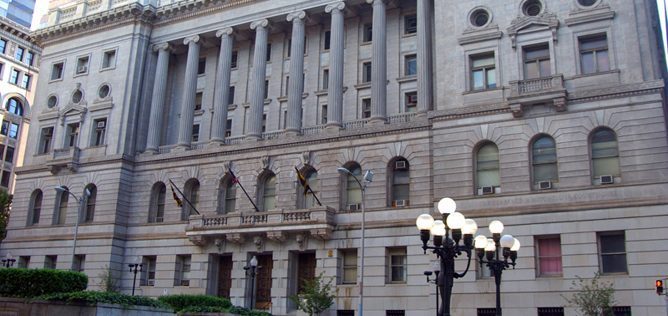
All criminal dockets are scheduled to begin at 9:30 a.m. If you are unclear about the location of your trial, please call 410-333-3811 or contact the Criminal Assignment Office located in Room 142 of the Clarence M. Mitchell, Jr. Courthouse. The judges assigned to the criminal docket may hear dispositions before other scheduled events. This allows attorneys who need to appear in other courts to be free to attend those proceedings following the completion of the disposition.  If a reason should arise that a trial cannot proceed as scheduled, the judge at Reception Court has the authority to rule on the request.

In an effort not only to meet the primary objective of trial delay reduction, but also to lower the recidivism rate, Baltimore City created a drug treatment court in 1994 for non-violent offenders in both the District and Circuit Courts. Defendants who are motivated and are otherwise eligible, can have their cases assigned for supervision to a special unit of the Baltimore City Division of Parole and Probation. These defendants enter guilty pleas for sentences which are suspended as long as they successfully participate in the program.

The Circuit Court for Baltimore City is constantly analyzing its procedures in an attempt to improve the efficiency of its operation. The reception court model was implemented in March 2007 and is functioning well. The overall goal of the court is to provide a timely, efficient and fair procedure for the trial of all cases.